Why innovation systems concentrate their gains
I trained as an architect and moved through urban planning into economics, chasing a way to make inequality tractable — to get it out of description and into equations, thresholds, and quantities that move. I do that from human centered design and engineering, which keeps the question of who a system is for attached to the formalism rather than downstream of it.
I am now building the models I kept needing and not finding. My work asks why innovation systems concentrate their gains, and follows that question down until the standard formal apparatus stops being able to represent it — from the institutional mechanisms that produce concentration, to their firm-level source in endogenous concavity, to whether the mathematics economics borrowed from classical mechanics can carry the explanatory weight placed on it.
The extension I am building treats growth as the feasible rate at which an economy expands its own possibility space, bounded by how fast human cognition and institutions can actually move. AI is a direct shock to that bound, which is why I am formalizing it now.
Advised by Dr. Stephen Turnovsky (Economics), Dr. Beth Kolko (Human Centered Design & Engineering), and Dr. Joshua Eisenthal (Philosophy of Science, Physics).
Research
Four strands of one question, at descending levels of abstraction.
Innovation System Inequality
Doctoral preliminary examination paper, 2025 · 158pp. with twelve supplements
Innovation studies has documented cumulative advantage qualitatively since Merton. I translate it into mechanism. Three institutional forces interact, and jointly they produce concentration exceeding what any one produces alone.
Innovation systems cluster into three regimes, not a continuum. Below 0.4 systems are stable and human-centered; above 1.4 they are self-reinforcing. Between roughly 1.1 and 1.7 lies a zone of mathematical instability, which is where social-democratic compromises sit. The boundary emerged from computational validation and stability analysis rather than theoretical deduction.
The three mechanisms, and what follows from them
Profit-filtering — problems without a business model never become visible. Cumulative advantage — early leads compound into permanent dominance. Adaptive resistance — concentrated interests coordinate against oversight faster than oversight can grow, and amplify super-linearly, pushing back hardest exactly when the challenge is most serious.
A boundary condition partitions innovation systems into three regimes with distinct stability properties: Market Fundamentalist, Human-Centered, and Social Democratic. Because the cross-partials are negative, reforms compound — comprehensive institutional change outperforms incremental adjustment by 2.17×, and prevention costs 4.5× less than correction.
Applied to AI governance, the framework places current arrangements at 1.011 against a critical threshold of 1.4: approaching the point at which technocratic control becomes structurally immune to democratic correction, but not yet past it.
The paper distinguishes computational coherence from empirical validation throughout, reporting fuzzy-set membership and Monte Carlo confidence intervals rather than point classifications.
Endogenous Mode-Switching
In preparation, with Dr. Stephen Turnovsky
Why do large firms escape diminishing returns? Standard growth theory treats the curvature of the production function as a fixed parameter. I make it endogenous.
Why this breaks Samuelson's comparative statics
Samuelson's comparative statics yield signed results precisely because concavity is exogenous. Firm size governs the number of qualitatively distinct modes a firm can operate across — production, R&D, lobbying, acquisition, IP licensing. Each mode diminishes individually, but a firm large enough to rotate between them faces weaker effective concavity, grows faster, and grows larger still.
The second-order conditions the standard apparatus depends on become variables rather than parameters, and identical policy shocks produce divergent responses across the firm-size distribution.
The concentration is structural. It follows from scale itself, not from conduct.
Foundations of the Formalism
In preparation, with Dr. Joshua Eisenthal
Samuelson imported the Lagrangian from classical mechanics — the physics of fixed state spaces and known constraints. Does that formalism carry its explanatory warrant across the transfer?
Predicting without explaining
This companion paper asks whether the experimental identifications that ground that formalism in physics survive the transfer to economics, or whether the borrowing yields a mathematics that predicts without explaining.
I treat the modeling and the critique as one project rather than two.
The Inter-Firm Epistemological Loop
Long-run research program
When firms produce knowledge they expand a shared epistemological commons, raising every other firm's capacity to discover new modes — which expands the commons again. New firm types emerge endogenously.
Why this needs mathematics that does not yet exist
The set of possible firm types is a variable, not a parameter. The dimensionality of the dynamical system becomes itself a dynamic variable, and you cannot write it as a fixed system of N equations because N changes as the economy evolves. This breaks the apparatus. This is beyond what fixed-dimensional optimization can represent.
It also reframes what growth is. Not optimization within a known space, nor expansion of a known space, but the speed at which the space itself can be revealed — bounded by how fast human cognition, institutional learning, and epistemological transmission can actually move.
Building the mathematics for this may require a second round of borrowing from physics — general relativity, quantum field theory, and Prigogine's dissipative structures: the physics of evolving state spaces and time-bounded possibility-expansion that did not exist when Samuelson borrowed the first time. Done, this time, with the critical awareness the companion paper develops.
AI, Work & Economy
The epistemological loop is a theory of the feasible rate at which an economy can expand its own possibility space — and that rate is bounded by human constraints: how fast people learn, how fast institutions adapt, how much friction knowledge meets in transmission.
AI is a direct shock to that bound. This is the reason to formalize the loop now rather than later, and it is also where the prelims paper's governance finding bites: the same window in which AI's economic structure is still contestable is the window in which the formal tools to reason about it need to exist.
My concern is not whether AI raises output. It is who holds the capacity to discover new ways of doing things, and whether that capacity concentrates the way every other advantage in an innovation system does.
Applied & Software Work
Earlier and ongoing work in urban informatics, data visualization, and participatory technology — where the questions above first came from.
Interactive AI for Strategic Decision-Making
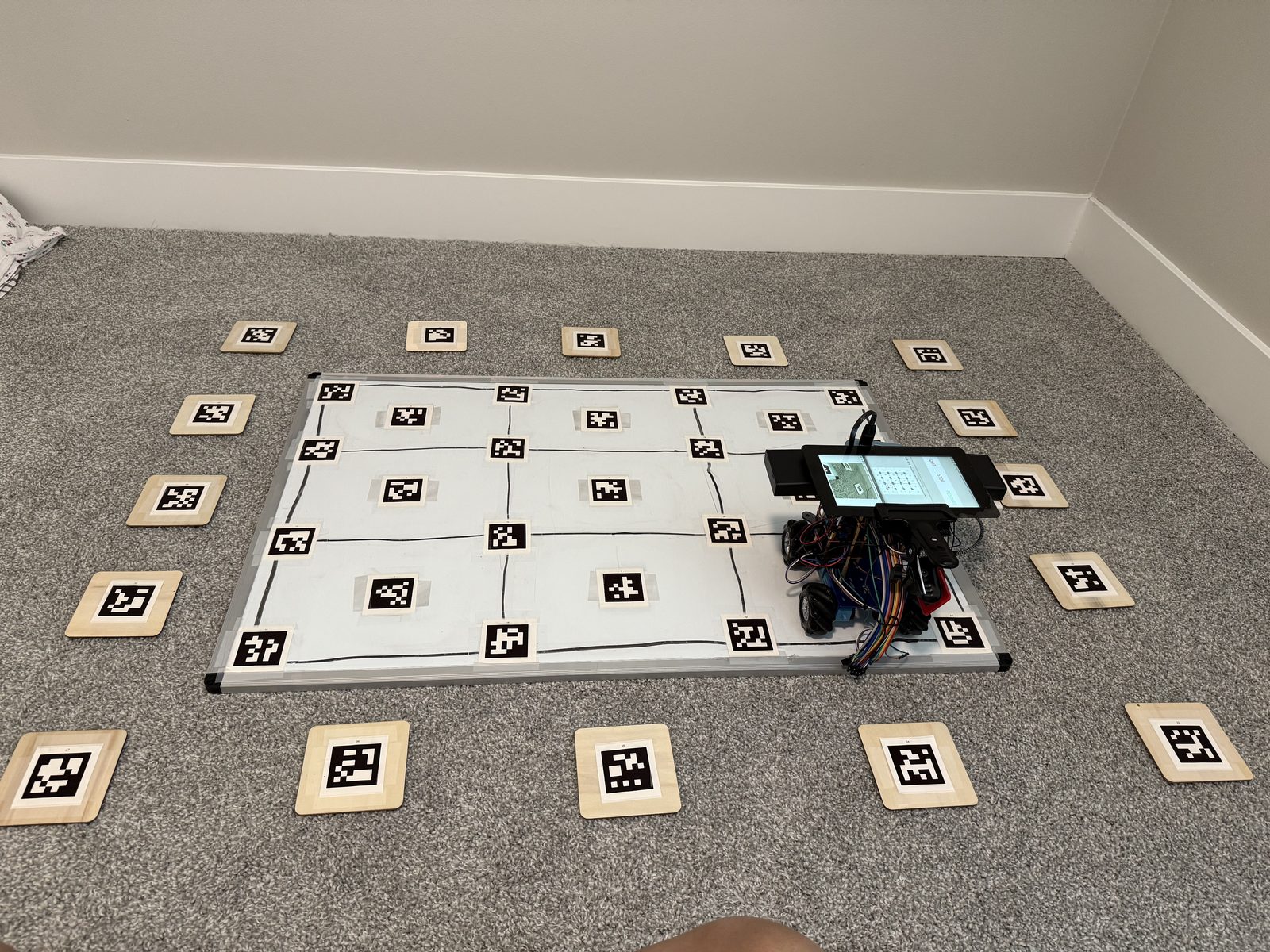
The myBloc Bot: a tangible decision-making system that integrates decision matrices with stakeholder input, built to explore how business strategy and governance decisions get structured in practice.

Transportation 2050
Data visualization for the Washington State Department of Transportation — D3, Tableau and Python dashboards built for political and agency stakeholders working with historical and forecast data. View project →
myBloc.city
A civic engagement platform for public participation in city planning decisions. Visit →
Tools
Connection Navigator, an Obsidian Canvas plugin for traversing the link structure of research notes, and a set of interactive JavaScript visualizations. Visualizations →